

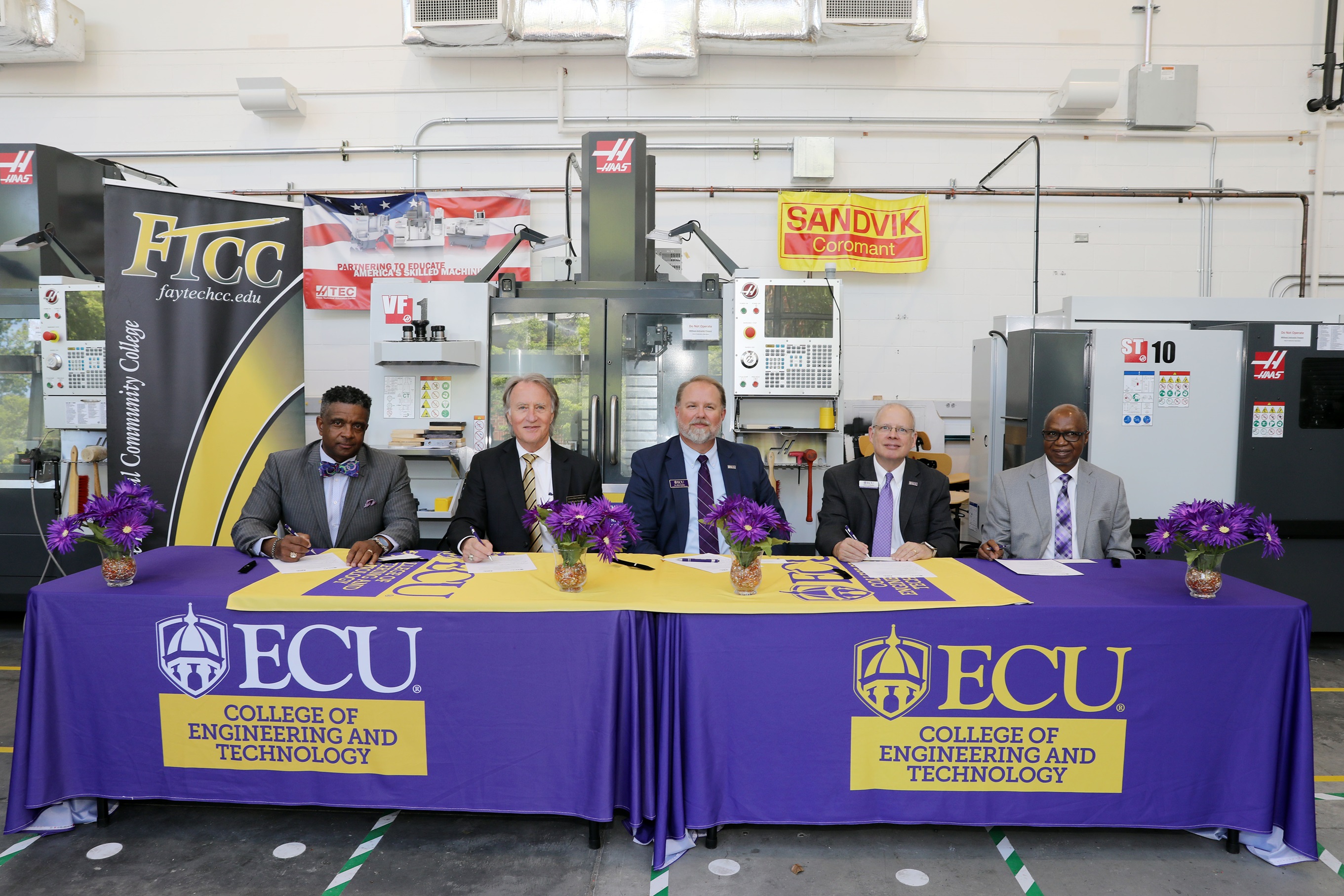
Fayetteville Technical Community College and East Carolina University signed a bilateral agreement last week, officially guaranteeing qualified FTCC graduates admission to ECU’s Bachelor of Science in Industrial Technology (BSIT) program.
The agreement, signed April 28 in Greenville, strengthens an existing partnership between ECU and FTCC. FTCC joined ECU’s Pirate Promise program — an agreement that allows students to attend special events, receive advising assistance and access other ECU resources before applying to the university — in 2020.
The BSIT agreement is especially valuable because it allows FTCC students who graduate with a qualifying Associate in Applied Science degree to transfer to an ECU program that offers most of its concentrations through online learning.
FTCC President Dr. Mark Sorrells voiced his appreciation of the program, which allows students to learn and work in their home communities.
“I am very partial to eastern North Carolina and the plight that individuals have to go through in being able to prepare themselves for the reality of the workplace, and there is no better place than East Carolina University in doing that and helping people stay rooted in the communities in which they were raised,” Sorrells said at last week’s signing. “That’s critically important because what we’re seeing is students leaving for college and never coming back. You’ve proven a model in your engineering, in the medical programs, in technology where they stay in eastern North Carolina.”
Dr. Harry Ploehn, dean of ECU’s College of Engineering and Technology, said the college’s online offerings have helped bolster its transfer rate from community colleges, the starting point for about 40 %of ECU’s students.
“A student in Fayetteville coming out of high school could in principle get a job, go to Fayetteville Tech and get an Associate in Applied Science (AAS) degree, be admitted to Pirate Promise and then pursue a four-year STEM degree in industrial technology at ECU without leaving their job, without leaving Fayetteville and without leaving their family,” he said in a press release.
ECU’s BSIT program offers seven concentrations — architecture design technology, bioprocess manufacturing, distribution and logistics, industrial management, industrial engineering technology, information and cybersecurity technology and mechanical design technology. Five of those concentrations can be completed fully online.
FTCC alumnus Jack Culbreth obtained his AAS degree in computer information technology and cybersecurity from FTCC before transferring to ECU. He began his ECU courses on campus but later switched to online learning.
“It’s honestly been really easy the way everything was set up nice for me,” said Culbreth in a press release. “I have no complaints at all.”
The newest agreement allows FTCC students who graduate with an AAS degree in any of five technical fields to transfer at least 53 credits toward their four-year degree, allowing them to complete their bachelor’s degree from ECU in two years.







The US Army Special Forces (SF), known as Green Berets because they are awarded a green beret to wear following the rigorous selection and training process, are specialized military units trained to conduct special operations. Photo provided by the G

Fuel to Serve will go “beyond the dining hall,” using food and shared meals as trusted entry points to link families with a broader network of resources. Photo courtesy of USAA.USAA and the Robert Irvine Foundation recently announced Fuel to Serve. T

Yes, those are decorations currently in my home. Yes, I may have spent more money than average for two oversized mums that are taking up way too much space on my porch, and yes, I may have stood my ground in a Lowe’s hardware store arguing with my hu