

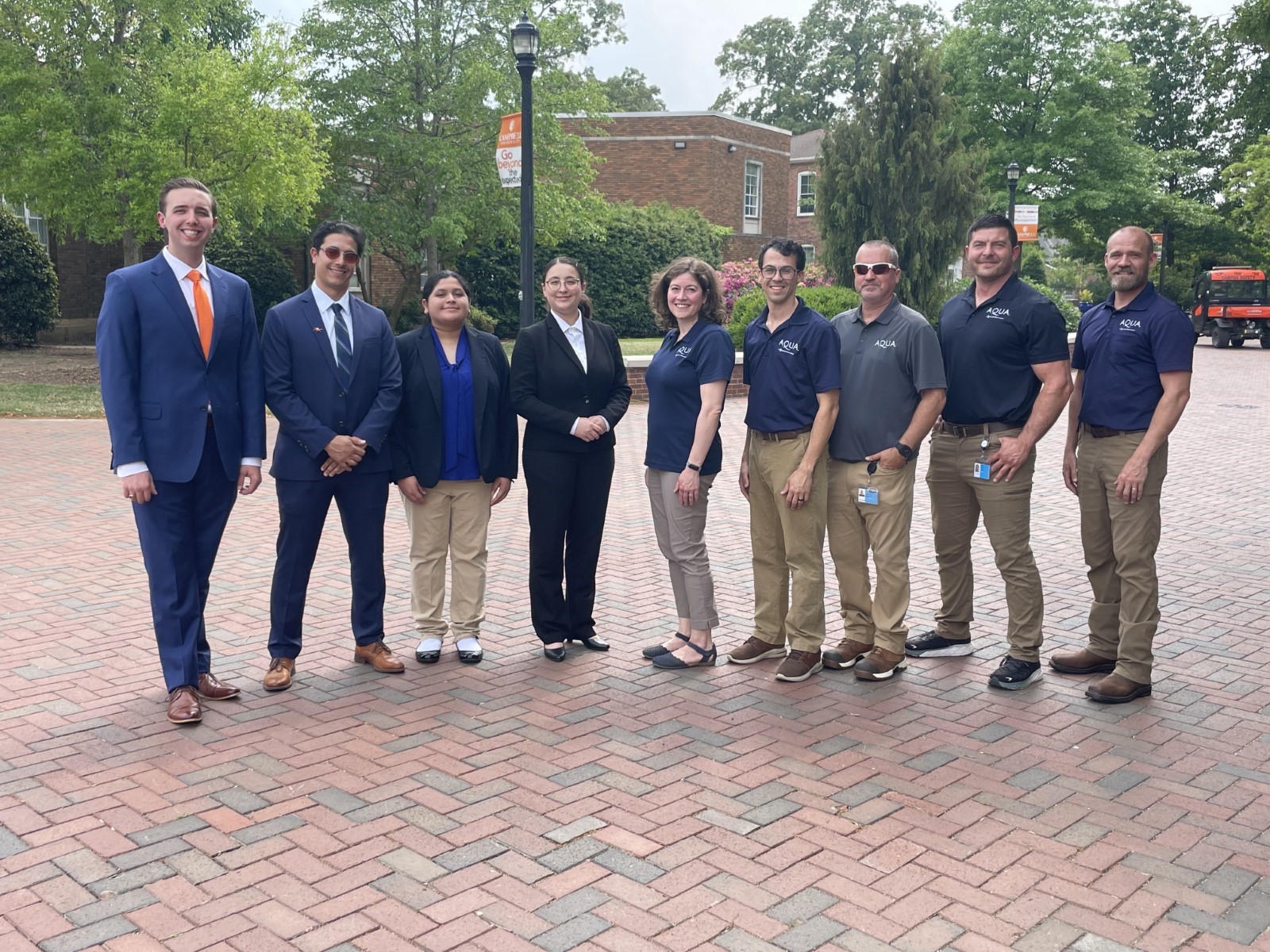
Aqua North Carolina announced its participation in Campbell University's School of Engineering Senior Design Program and has tasked a team of students with developing a media changeout device for Aqua's advanced water filter treatment systems.
On April 22, Campbell University School of Engineering students Tahir Boughrara, Parker DuBose, Leilani Duncan and Andrea Padron gave their final presentation for their senior design project, sharing proof of design/concept and summarizing how they developed and tested their prototype. Aqua sponsored this two-semester program consisting of regular meetings where students learn the basics of project management and engineering design concepts.
“It has been exciting to be a part of the Campbell Senior Design Program,” said Aqua North Carolina Project Engineer Daniel Taylor, E.I., in a press release. “As a former Campbell student, I understand and appreciate the real world experience the program offers.”
Taylor received his Bachelor of Science in Mechanical Engineering from Campbell University in 2020.
Aqua North Carolina provides safe and reliable drinking water to over 730 ground water systems. Currently, Aqua operates over 300 water filters. The filter media used in advanced water treatment processes has a lifespan anywhere from two to over 20 years. Once it reaches the end of life, media changeout is necessary. This process involves removing the used media and installing new media into the same vessel. The current media changeout procedure is physically challenging and requires multiple employees across multiple days to complete. Aqua tasked the Campbell University Senior Design team to review the current media procedure and identify an alternative method for media changeout.
The Senior Design team spent the fall semester understanding the challenges through site visits, data review and interviews of Aqua employees. They used this information to brainstorm solutions that considered efficiency, safety, adaptation, durability and mobility. In December 2024, the team finalized their design concept and presented their findings to Campbell faculty and their classmates. This spring, the team transitioned into the testing phase of their project, incorporating feedback from Aqua’s staff to inform the design. This feedback led to the selection of a conveyor system to safely move the media into the treatment vessel and the development of an initial small-scale prototype for testing.
“Our Engineering team has enjoyed providing support as an industry sponsor,” said Aqua North Carolina President Shannon Becker in a press release. “We are always looking for young professionals to join our team who have already developed effective communication and problem-solving skills through their undergraduate work.”
The prototype designed by the Campbell Senior Design team met the goals set forth at the beginning of the school year. Aqua looks forward to reviewing the design documents prepared by the students and incorporating their findings to finalize a full-size design for future use in the field.
“The mentoring relationship is a huge part of this program because it really gives students access to and insight to how projects work in a corporate environment,” said Campbell University’s Dean of Engineering Dr. Jenna Carpenter in a press release. “We know that it’s a lot of work on our industry sponsor’s part and we appreciate Aqua’s time to make this project a success.”






The US Army Special Forces (SF), known as Green Berets because they are awarded a green beret to wear following the rigorous selection and training process, are specialized military units trained to conduct special operations. Photo provided by the G

Fuel to Serve will go “beyond the dining hall,” using food and shared meals as trusted entry points to link families with a broader network of resources. Photo courtesy of USAA.USAA and the Robert Irvine Foundation recently announced Fuel to Serve. T

Yes, those are decorations currently in my home. Yes, I may have spent more money than average for two oversized mums that are taking up way too much space on my porch, and yes, I may have stood my ground in a Lowe’s hardware store arguing with my hu