
Fayetteville State University is reshaping its academic foundation to better prepare students for a rapidly evolving workforce, with particular emphasis on artificial intelligence and real-world experience.
The university is in the midst of revising its core curriculum to modernize it and make sure that it is consistent with what’s necessary without being overly burdensome on students. FSU recognizes that AI is the most significant transformational force in both higher education and the broader economy. To meet this moment, the university is planning an institution-wide certificate in the foundations of artificial intelligence for all students, regardless of major.
The vision is for a four-course sequence integrated into existing degree pathways so that credit loads do not increase. Rather than learning to cognitively offload mental work onto Claude or ChatGPT, students will learn how to use AI as a tool and how it can be incorporated into daily operations in their specific field. Instructors will instill in their students the principle that students should always hold the power in the human-machine interface.
Early courses in the freshman and sophomore years will introduce fundamental AI concepts, history and basic tools. Later courses in the junior and senior years will be discipline-specific, focusing on how AI applies in a student’s particular field and how those tools are evolving. The goal is not just to graduate students who know today’s tools, but students who walk out the door ready to learn and able to quickly get up to speed with whatever AI systems their future employers are using.
By being on the leading edge of AI adoption and integration, FSU aims to ensure its students are just as competitive as graduates from competing universities. To support this, FSU is partnering with industry leaders Lenovo and Intel, who will help shape curriculum design, inform delivery and bring current industry practices into the classroom.
Internships and professional readiness are the second major pillar of FSU’s workforce strategy. While the university already places many students in strong internship roles, the goal is to connect even more students with these opportunities. To do this, FSU is partnering with Braven, an organization that collaborates with regional public universities and institutions to build students’ professional skills and connect them with more robust internship pipelines.
The plan is to integrate Braven’s professional development components into a second-year experience, so that students in their sophomore year are better prepared to interview, step into workplace environments and succeed in internships that can become pathways to full-time employment.
The university is planning to roll out the foundational AI coursework by around fall 2027, potentially piloting earlier in smaller online or summer formats. It is also actively seeking student feedback through a broad survey to gauge perceptions of AI in the curriculum. On the faculty side, an internal survey has already shown that roughly 87% of faculty are engaging with AI in their teaching in some fashion, signaling institutional readiness and enthusiasm, even as some concerns remain about plagiarism and overreliance on AI tools.
These adjustments to the curriculum will not replace the university’s emphasis on areas like quantitative literacy, qualitative thinking, critical thinking and communication, which continue to prove valuable in the workforce. FSU’s vision is to marry strong liberal arts foundations with cutting-edge AI literacy and structured professional development.
By revising the core curriculum, embedding an AI certificate for all students, expanding internship networks and leveraging strategic partnerships, the university aims to graduate students who are not only technically and intellectually prepared, but also adaptable, critically minded and ready to thrive in a fast-changing workforce.





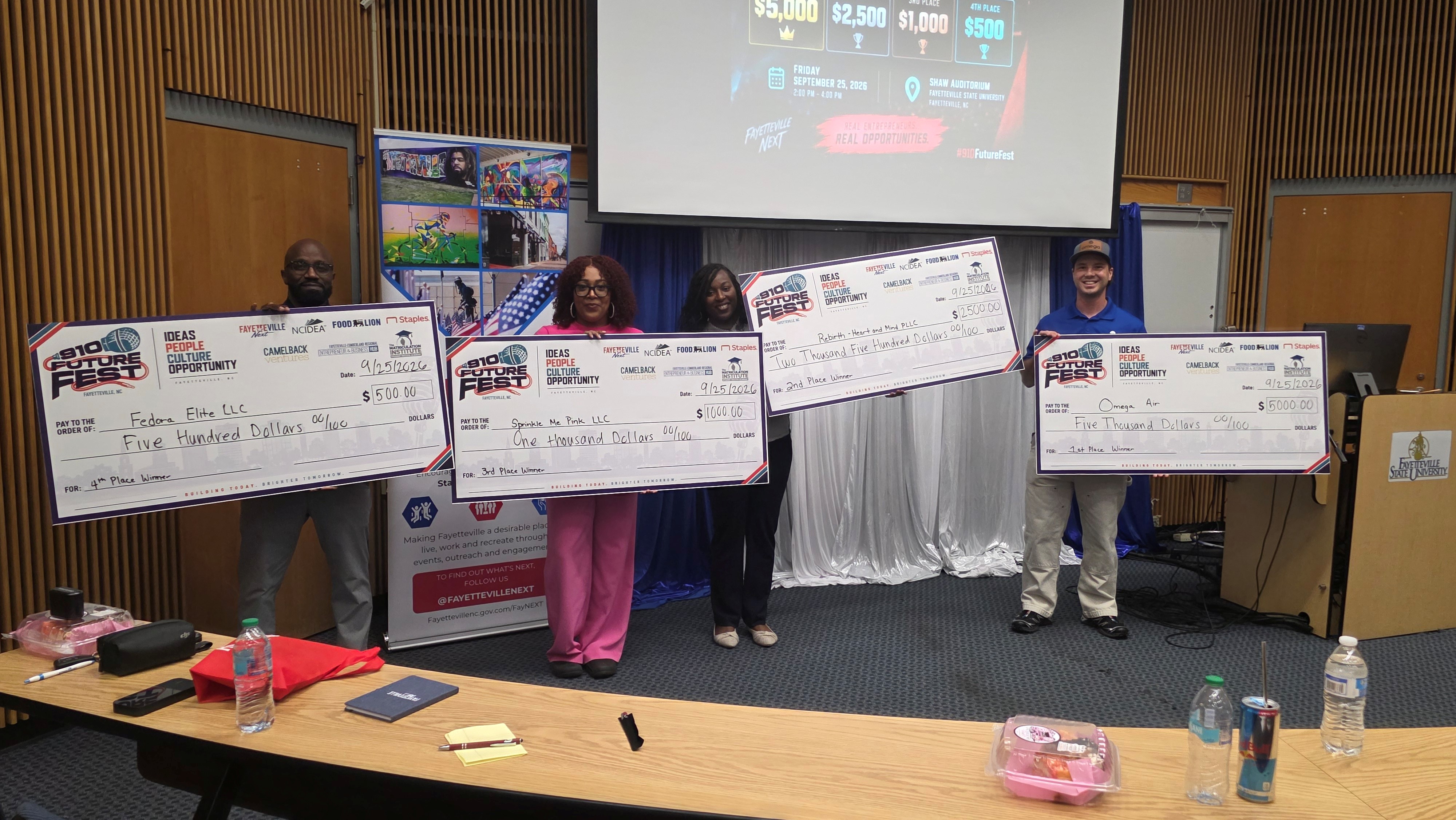
Winners of the inaugural pitch competition were Omega Air, Rebirth-Heart and Mind PLLC, Sprinkle Me Pink, LLC and Fedora Elite Mobile Cigar Experience. Following an event-packed weekend, four Fayetteville-based entrepreneurs were given a leg up