

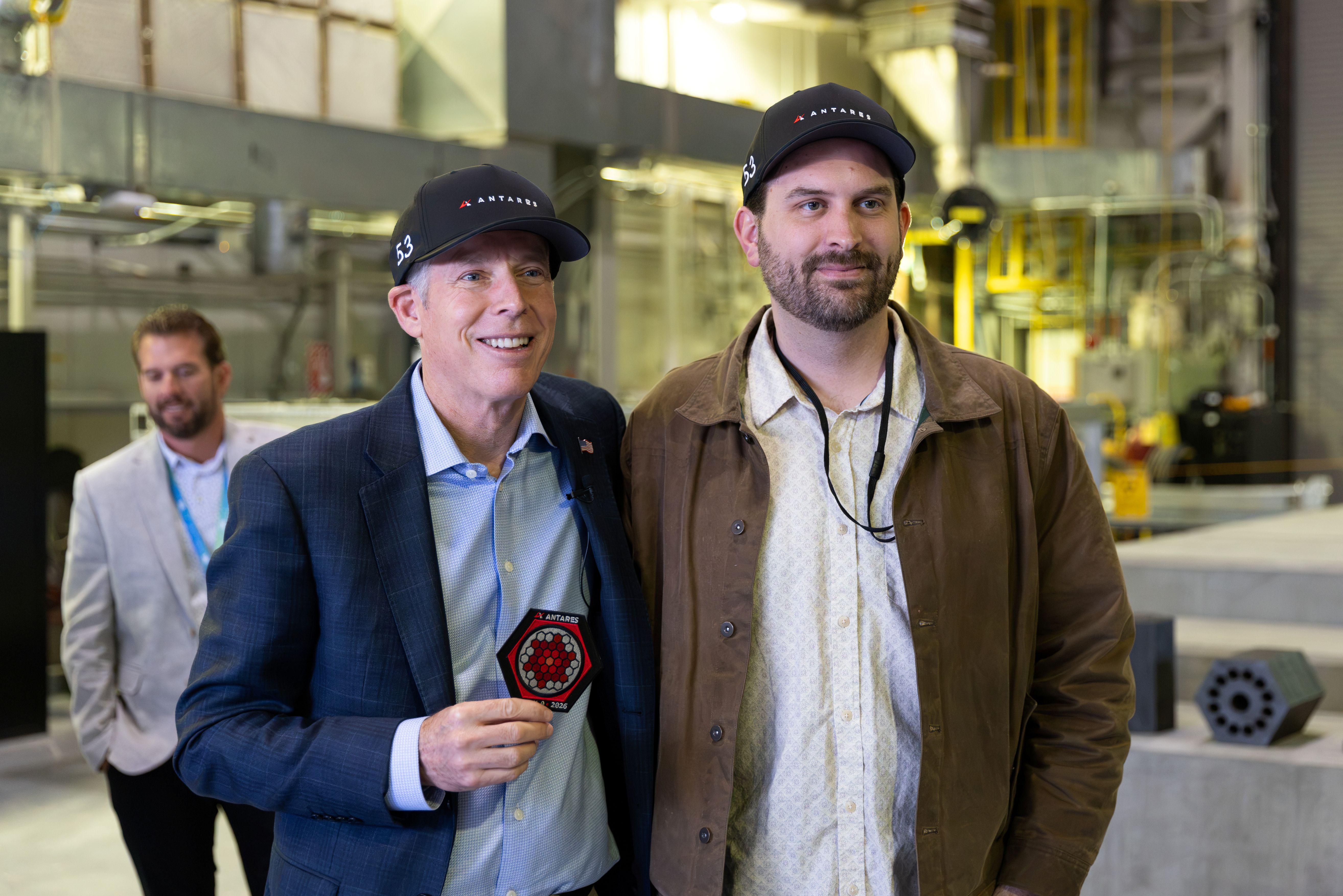
Antares Nuclear, Inc. recently announced that it has been awarded an Other Transactions Authority agreement under the U.S. Army’s Janus Program. The U.S. Army and Defense Innovation Unit selected Antares to own, construct and operate nuclear microreactor power at Fort Bragg, N.C., in support of the Army’s energy resilience mission.
“Antares exists to solve a problem, and that problem is that energy scarcity is constraining America’s most critical defense systems…it’s really through the Army’s Janus Program that Antares is going to deliver clean, firm, resilient power to the warfighter. And we couldn’t be more excited about doing it at Fort Bragg,” said Antares Head of Federal Strategy and Policy Tom Mancinelli.
The Army, the Defense Innovation Unit and a panel of nuclear experts drawn from the Department of Energy, the national laboratories and across the Services selected Antares after rigorous technical due diligence. Evaluated against the field of competing designs, Antares’ TRISO-fueled, factory-produced microreactor emerged as one of the most mature and deployment-ready solutions.
“Fort Bragg is already one of our country’s most prized military installations, and this further cements its place as a true place of innovation for the warfighter…we want our military, our warfighters, to have the electricity they need for the modern battlefield. Electricity demand is only increasing on the modern battlefield, and we don’t want to see the warfighter constrained by a vulnerable electrical grid or long liquid fuel logistics resupply chains, and so what we really want to do is provide resilient energy in the form of our microreactors,” explained Mancinelli.
Antares was founded in 2023 and was selected for the Department of Energy’s Reactor Pilot Program in 2025. The company achieved first criticality of its Mark-0 reactor at Idaho National Laboratory on June 4, 2026. Its Mark-0 was the first reactor to reach that milestone under the Department of Energy’s Reactor Pilot Program. Janus extends that momentum from demonstration toward deployment, advancing the Army’s goal of operating an Army-regulated reactor on an Army installation by September 2028 under Executive Order 14299.
“We’re grateful and proud to partner with the U.S. Army and the Defense Innovation Unit on the Janus Program,” said Jordan Bramble, CEO and founder of Antares, in a press release. Janus uses a milestone-based payment structure under which vendors are funded only after meeting defined technical goals, an approach that rewards execution and accelerates the delivery of resilient power to the field. Antares’ selection reflects the maturity of its TRISO-fueled, factory-produced microreactor and the operational heritage already being established through its test campaigns at Idaho National Laboratory.
“The Janus Program is about transitioning from designs and experiments to reliable commercial hardware which secures our energy independence,” said Principal Deputy Assistant Secretary of the Army for Installations, Energy and Environment Dr. Jeff Waksman in a press release. “The Janus Program vendors were selected through a deeply rigorous evaluation on technical, financial and organizational capabilities conducted by an All-Star panel of dozens of experts from across the nation. We look forward to working alongside each team as they proceed toward successfully completing the rigorous technical milestones we’ve agreed upon.”
The reactor is expected to be operational at Fort Bragg in 2028. The goal is to produce one megawatt per core of the reactor.
“Between our contracts to deploy dozens of reactors under Janus for the Army, ANPI for the Air Force, and space nuclear for the Space Force, we now have a contract value on the order of $1B that is growing rapidly,” Bramble added in a press release.
Microreactors offer a uniquely resilient power source for defense-critical infrastructure, running for years without refueling and operating independent of the commercial grid or vulnerable liquid-fuel supply chains. As warfighting increasingly depends on assets based at installations across the United States — command and control, missile defense and strategic deterrence among them — reliable, onsite power has become a mission imperative.
For the broader Fayetteville community, the Antares project represents a significant longterm investment at Fort Bragg and in the region. The company has emphasized a “safety first” transparent approach and says it intends to be a long-term partner to the community.
“This is the moment where we, as a startup company, go from proving our reactor to putting the reactor to work at Fort Bragg, and we’re certainly excited about being a part of the larger Fayetteville community,” added Mancinelli.
To learn more about Antares, visit www.antaresindustries.com.






Hello, loyal readers. I am writing to you as someone older and therefore wiser (okay, I’m actually writing this the day before my birthday, but you will receive your copy after I’ve already celebrated). I was reminded of how truly blessed I am t

Renaissance offers a broad range of massage services, from standard Swedish and deep tissue massages to signature massages that offer clients aromatherapy, a farmhouse-sourced “honey heel glaze” foot treatment and hot stone therapy. Photo by Style To
Nikole (pictured) and Lakota Shawn began selling their meat at farmers markets and in an online store in 2024. Now, they’ve opened their first brick-and-mortar location. Photo by GFBJ.The Shawn family believes in quality, locally sourced food, and th