
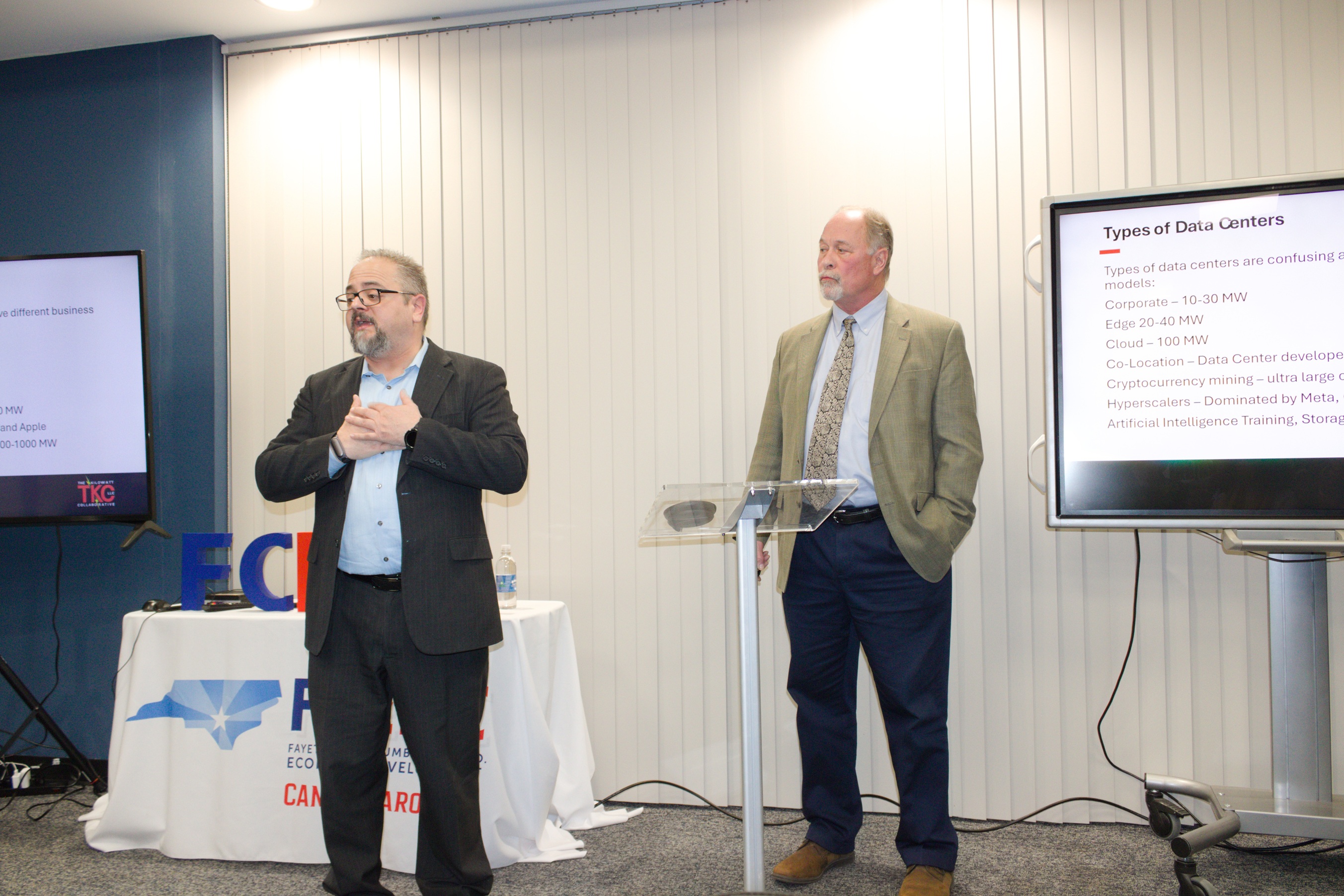
On Thursday, Jan. 29, the Fayetteville Cumberland Economic Development Corporation hosted a public information session on data centers. The session provided details on how data centers operate, what is driving their growth and how communities can benefit from their economic growth while ensuring residents are protected.
“Data centers are coming and expressing interest, and we really think that we need to have a community-wide conversation about what we want, where they might be acceptable,” shared President/CEO of FCEDC Robert Van Geons.
The speaker for the event was John Geib, the founder for a small consulting firm called The Kilowatt Collaborative LLC. Before that, Geib had a career with Duke Energy.
Geib traced the history of large data centers from the early internet boom of the 1990s, through a first wave of facilities recruited to the Carolinas in the 2000s, to the more recent emergence of both cryptocurrency mining operations and ultra-large artificial intelligence–driven centers. Early data centers in North Carolina typically required 20–30 MW of power, a level utilities could accommodate relatively easily.
Today, some prospects are asking for 200–500 MW at a single site. The largest site Cumberland County is currently capable of supporting is a hyperscaler, or a 300-500 MW facility. A/I training data centers that are popping up across the country require 1000 MW and beyond.
Data centers can contribute a substantial tax base, create jobs and, under the right conditions, help lower the average cost of electricity by spreading fixed utility costs over more usage. However, this benefit depends on having sufficient existing generation capacity. Duke Energy currently has roughly 35 GW of capacity across the Carolinas, with peak demand approaching 28 GW, leaving a reserve margin needed for reliability. As more large power users connect to the grid, that margin shrinks, eventually triggering the need for new generation resources, which causes an increase in costs.
Policy changes have been made at the state level to try to prevent data center costs from increasing rates to all customers. Requirements such as the project must fund transmission costs upfront, customers must own the land and have it zoned/entitled for data centers and customers must agree to interrupt service 100 hours per year were all implemented to rein in the development of these centers. Now, change is needed at the local level to prepare for the undeniable growth of this sector.
This was just the first in what is expected to be a series of public information sessions regarding the presence of data centers in Fayetteville and Cumberland County. Currently, there are talks of two data centers going up in Fayetteville. These include a data center proposed for Dunn Road that is 300 MW, and another data center proposed for Custer Avenue.
“We want them [elected officials] to have a series of policies and programs and zoning that specifically address this sector that's growing,” added Van Geons.
There is widespread pushback from residents and businesses regarding the impending arrival of new data centers. The community must move quickly to develop thoughtful local regulations and engage elected officials to ensure growth serves the public interest.





The US Army Special Forces (SF), known as Green Berets because they are awarded a green beret to wear following the rigorous selection and training process, are specialized military units trained to conduct special operations. Photo provided by the G

Fuel to Serve will go “beyond the dining hall,” using food and shared meals as trusted entry points to link families with a broader network of resources. Photo courtesy of USAA.USAA and the Robert Irvine Foundation recently announced Fuel to Serve. T

Yes, those are decorations currently in my home. Yes, I may have spent more money than average for two oversized mums that are taking up way too much space on my porch, and yes, I may have stood my ground in a Lowe’s hardware store arguing with my hu