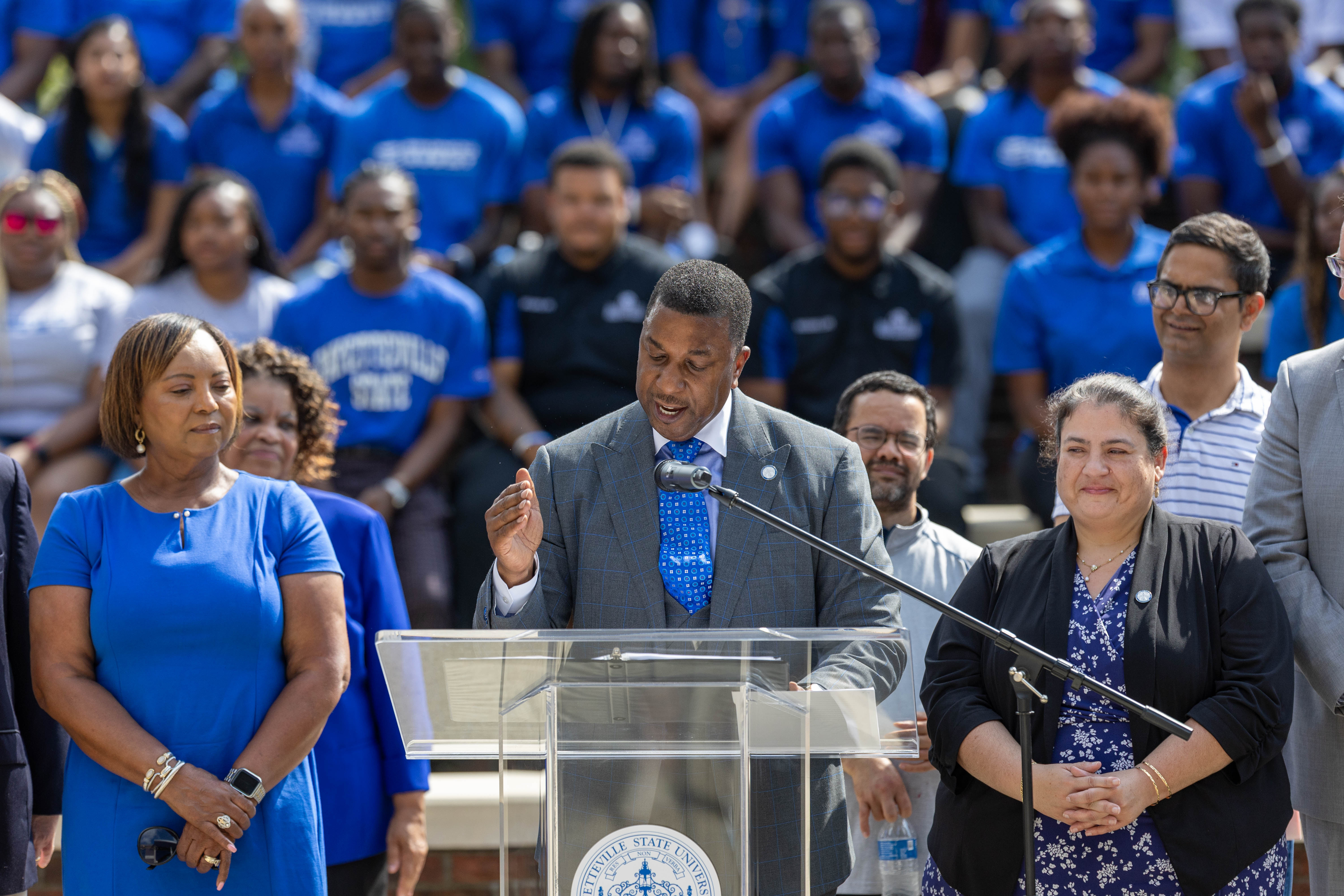
Fayetteville State University announced today a $6.5 million commitment from Anonymous Trust, the largest gift in the University's history — as Chancellor Darrell T. Allison unveiled an unprecedented summer enrollment peak of 4,827 students during a special campus announcement.
“Our students are showing us that summer is an essential part of their academic journey,” Baldwin, vice chancellor for strategic enrollment, said. “The record enrollment announced today reflects their determination towards degree completion and their future.”
The gift covers tuition, housing and meals for students enrolled in the University's 30-60-90 Free Summer School Program. It is the trust's second multi-million-dollar investment in FSU in three years, surpassing the more than $5.8 million it committed in 2022 that funded student success initiatives. A community-focused funder working to elevate and empower rural, under-resourced and marginalized communities across eastern North Carolina, Anonymous Trust invests in grassroots organizations and partnerships with larger institutions to drive systemic change, an approach that has made it a foundational partner in FSU's three-semester model.
During the campus event, Allison also expressed gratitude to the trust and state leaders following the official signing of North Carolina's budget bill. The new legislation secures a recurring $2 million annual state allocation to sustain and scale the 30-60-90 initiative. This funding is part of a comprehensive $16.5 million state investment package for FSU.
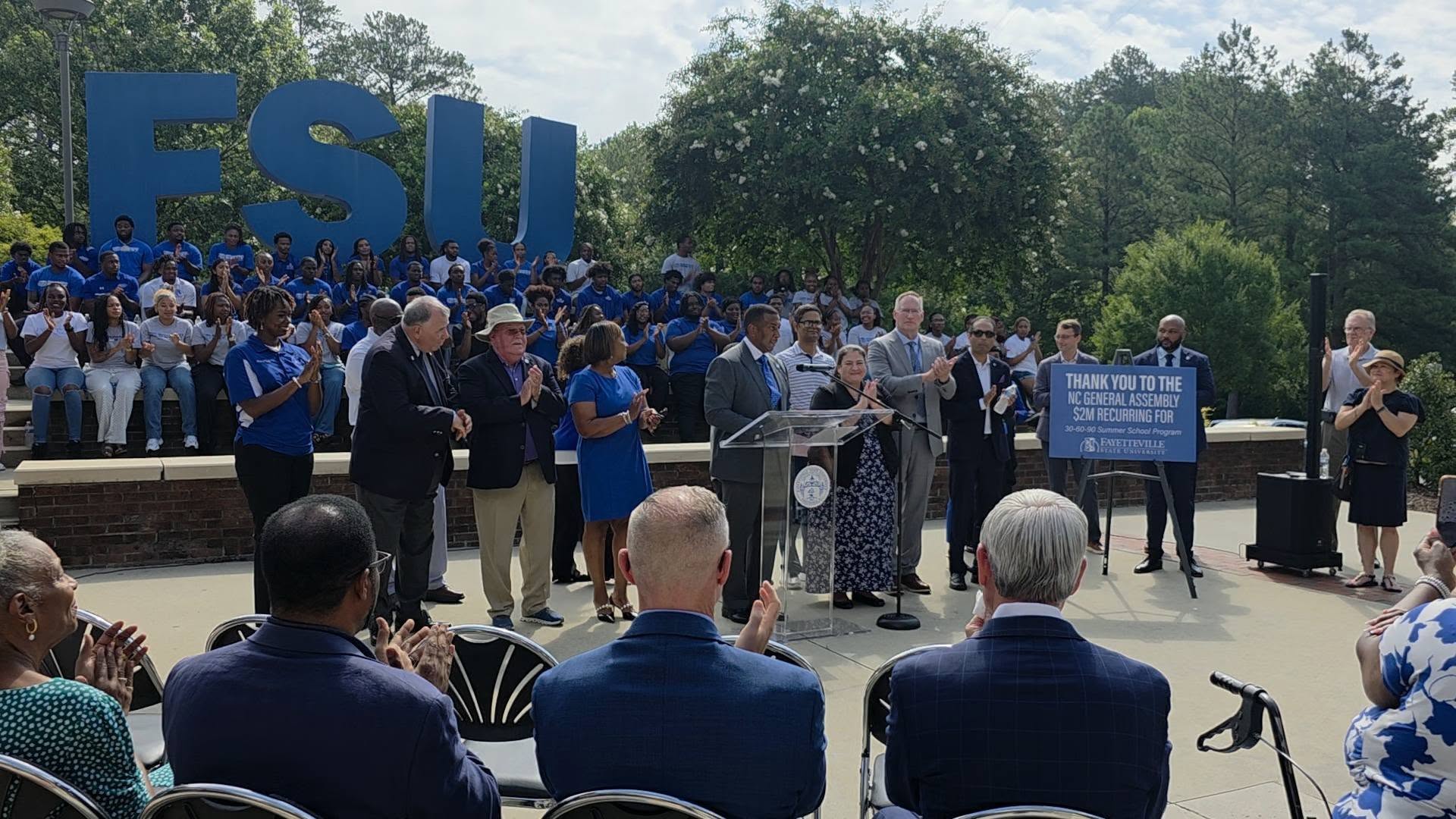
“Today’s announcement represents what can happen when students are given the resources and opportunity to keep moving forward,” Allison said during the celebration event. “We are grateful to the North Carolina General Assembly, led by House Speaker Destin Hall in the House and Senate President Pro Tempore Phil Berger of the Senate, and Gov. Josh Stein for investing in a program that is strengthening degree completion at Fayetteville State. We also thank UNC System President Peter Hans for his continued advocacy on behalf of our University and our students.”
The new state support gives FSU greater capacity to preserve summer opportunities as participation grows. It also strengthens the partnership among the university, private donors and state leaders that has helped students continue earning credits while limiting additional educational costs.
“This investment allows Fayetteville State to build upon a model that has already demonstrated measurable value for our students,” Allison continued. “We have a responsibility to use these resources wisely, continue improving student outcomes, and ensure that more Broncos have a clear path to completing their degrees in four years or less.”
The initiative is organized around the academic milestones students must reach to remain on pace for graduation, beginning with 30 credit hours for sophomore standing, continuing through 60 credits for junior standing, 90 for senior standing, and 120 for degree completion.
“The 30-60-90 Summer School Initiative is more than a summer school program; it is a proven student success strategy that helps students maintain academic momentum, reduce time to degree, minimize debt, and stay on the path to graduation,” said Shun Robertson, senior vice president for Strategy and Policy at the UNC System.
For students facing financial or academic barriers, summer coursework can help prevent delays caused by an incomplete prerequisite, a missed course or the cost of attending an additional term. Earning up to seven credits during the summer can also reduce the likelihood of needing an extra semester to finish a degree.

“When I chose Fayetteville State University, I came through with one goal in mind – to earn my degree, become a nurse, and make my family proud,” said Brooklyn Edwards, a senior nursing student who spoke during the celebration. “Because of the 30-60-90 summer school initiative, I’ve been able to stay on track to graduate within four years, while successfully navigating the rigorous demands of nursing school. Instead of worrying about the cost of summer tuition, I’ve been able to focus my time and energy on my coursework, preparing for clinicals, and becoming the best future nurse I can be.”
“To know that the state leaders continue to invest and push forward and give us the trust to have this funding – it means a lot,” said Alecia O’Kelly, a psychology student.
The program has produced a measurable financial benefit. FSU estimates that students have avoided more than $4 million in summer loan borrowing since the initiative began, and average summer loan originations per full-time equivalent student have declined approximately 75% since 2020.
The announcement comes as FSU continues to improve its four-year graduation rate. The University reported a 25% four-year graduation rate for the 2021 entering cohort, up from a 19% baseline, and has set a goal of reaching 50% by 2031.
According to Allison, this program’s continued success helps build a bridge between working students and their ability to access an affordable education. He shared that over 63% of FSU students are working 20 hours or more a week, and 82% come from Tier 1 or Tier 2 counties.
“We've seen momentum in an upward trajectory. [As] we heard from the UNC system, we are leading by far in the rate increase of the graduation rate in four years. For our retention, we had one of our highest last year that was announced at 78% up from 63%, and we're thinking in both of those areas we're going to hit some historic numbers here in August,” shared Allison during an interview with GFBJ. “We've seen over the years the private sector step in, and here finally, the state steps and it cements this concept for Fayetteville State University; we now have a permanent semester during summer.”
FSU streamed the full celebration event live on Facebook, which can be found here.





Hello, loyal readers. I am writing to you as someone older and therefore wiser (okay, I’m actually writing this the day before my birthday, but you will receive your copy after I’ve already celebrated). I was reminded of how truly blessed I am t

Renaissance offers a broad range of massage services, from standard Swedish and deep tissue massages to signature massages that offer clients aromatherapy, a farmhouse-sourced “honey heel glaze” foot treatment and hot stone therapy. Photo by Style To
Nikole (pictured) and Lakota Shawn began selling their meat at farmers markets and in an online store in 2024. Now, they’ve opened their first brick-and-mortar location. Photo by GFBJ.The Shawn family believes in quality, locally sourced food, and th